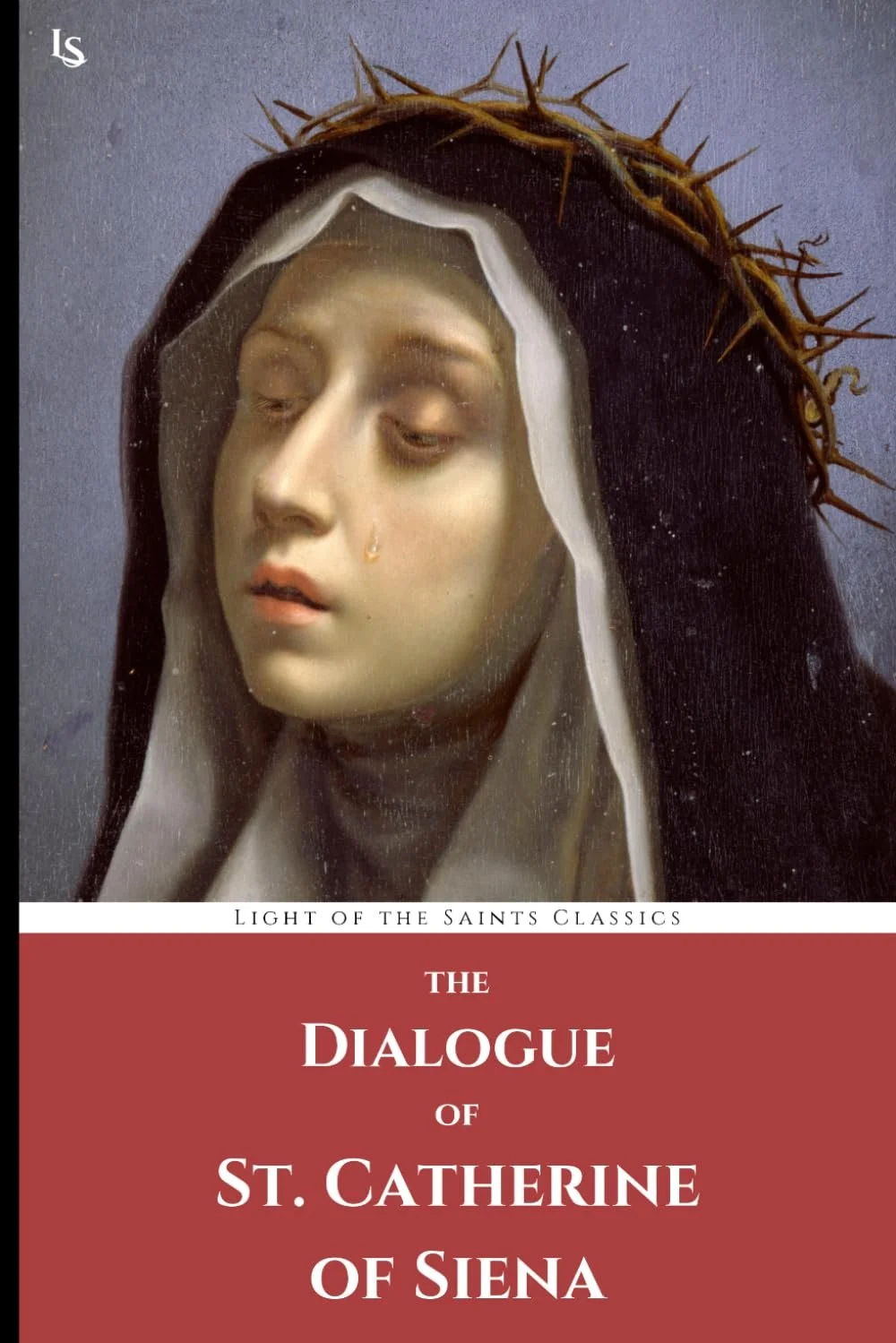
“Then God, turning the eye of His mercy towards her, allowing Himself to be constrained by her tears, and bound by the chain of her holy desire, replied with lamentation—‘My sweetest daughter, thy tears constrain Me, because they are joined with My love, and fall for love of Me...’”
The Dialogue was dictated by St. Catherine of Siena to her secretaries while she was in an ecstasy. As one might expect from the extraordinary circumstances of its production, the work has a special interest for Christians everywhere. In its pages we have a great saint, one of the most extraordinary women who ever lived, treating, in a manner so simple and familiar, of the elements of practical Christianity.
The composition of this exceptional laywoman (whose will, purified and sublimated by prayer, imposed itself on popes and princes) is an almost unique specimen of what might be called ecclesiastical mysticism. For its special value lies in the fact that, from first to last, it is a mystical exposition of the creeds taught to every child in Catholic schools. Still, her insight is very wonderful. How subtle, for instance, is the analysis of the state of the worldly man who loves God for his own pleasure and profit! The special snares of the devout, too, are cut through by the keen logic of one who has experienced and triumphed over them.
Passages occur frequently of lofty eloquence, and also of such literary perfection that the book is held by critics to be one of the classics of the age and land which produced Boccaccio and Petrarch. Every well-known form of Christian life, healthy or parasitic, is treated of, detailed, analysed incisively, remorselessly, and then subsumed under the general conception of God’s infinite loving-kindness and mercy.
This edition is a reprint of the classic 1907 abridgement of Algar Thorold’s translation.